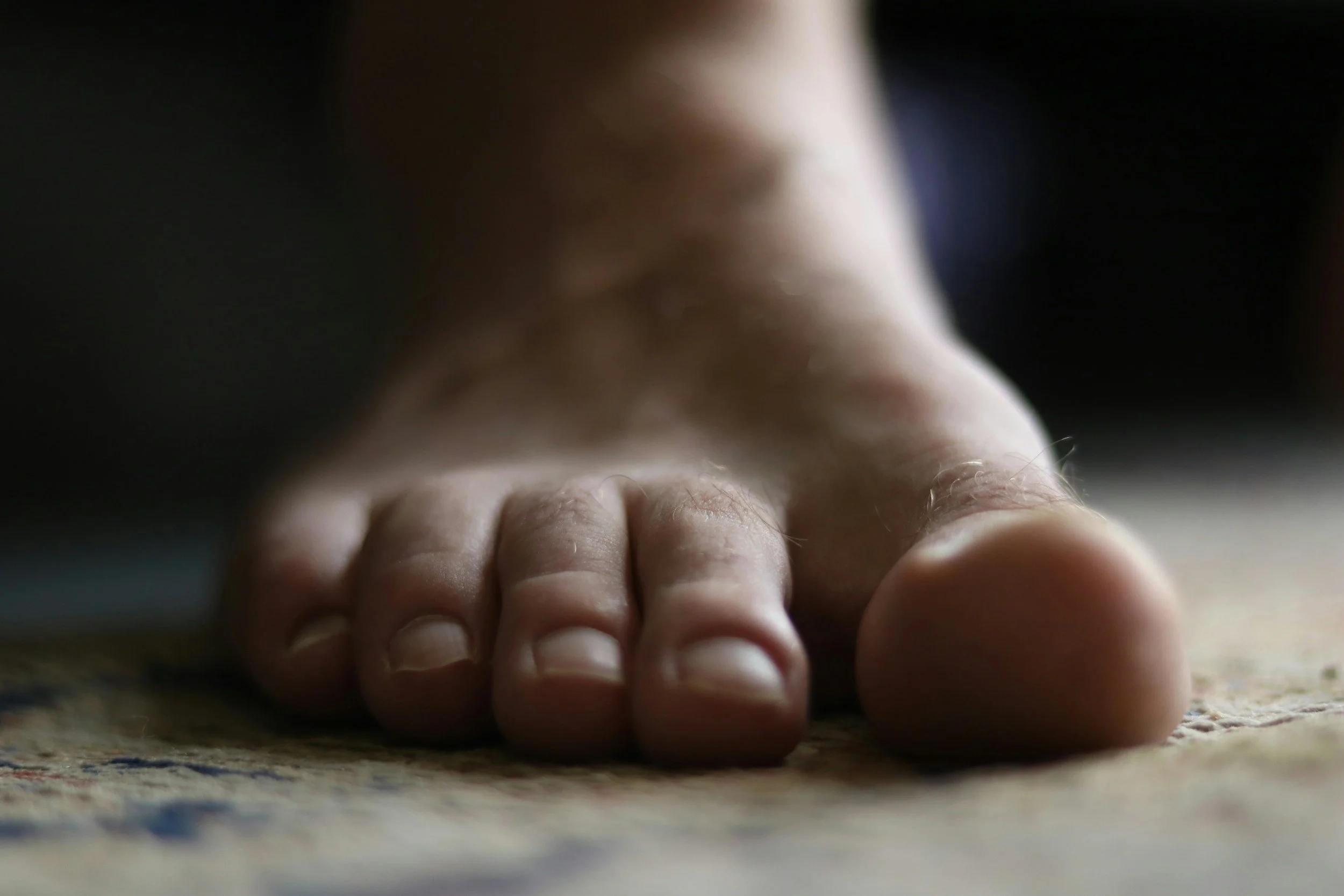
I’m often struck by stories from those I teach who’ve had a distressing experience of being told by a Yoga or similar instructor to ‘let go’. For someone in chronic pain with a nervous system that’s learned to predict threat, letting go can feel profoundly unsafe. If your body has frequently encountered unsafe sensations, it may never have properly registered a safe one. This is where grounding comes in.
If you’ve lived with chronic pain or with anxiety, you’ll know the strange experience of feeling unsettled in your own body. Present, but not quite here. Some people describe it as floating, as though they’re moving through the world without ever fully landing. There’s a good reason for that feeling, and understanding it is often the starting point for recovery.
Your body’s internal GPS
Deep in your inner ear and brainstem sits a remarkable sensory network called the vestibular system. It gives your brain constant information about motion, head position, and where you are in space. It’s what keeps you upright, coordinates your eye movements and helps you navigate a room without thinking about it. In many ways it acts as your body’s internal GPS.
When this system is working well, you feel something so basic you rarely notice it: the pull of gravity holding you in your chair, your feet on the floor, anchored to the earth. The occupational therapist Jean Ayres, a pioneer of the study of sensory integration, describes this beautifully:
One of the most basic of all human relationships is our relationship to the gravitational field of the earth. This relationship is even more primal than the mother-child relationship. Sensory integration of the vestibular system… does give us gravitational security, the trust that we are firmly connected to the earth and will always have a safe place to stand.
For Ayres, gravitational security is also the foundation on which we build our relationships with others.
When our balance system is interrupted, or has never been fully able to develop, we lose our internal map. It becomes difficult to know where we are in space and, equally importantly, difficult to feel held firmly enough to defend ourselves or connect with others. Without a centre of gravity we’re left floating.
This matters enormously for anyone recovering from chronic pain or persistent anxiety because the balance system has two roots. One connects to the part of the brain responsible for embodiment, our felt sense of being in our body. The other connects to interoception: our ability to know what we’re actually feeling and sensing inside.
Both parts of the system shape much more than our posture. They influence our capacity for purposeful movement, our ability to notice and regulate our emotions, capacity to connect with others, sense of curiosity and ability to feel truly present in the here and now. When someone’s been surviving by floating rather than landing, all of this is harder to access.
Our relationship to gravity develops early and relationally. In a secure early relationship, a caregiver will naturally activate a child’s balance system through rocking, mirroring and attuned physical holding. Our sense of being safely held by the earth and of being safely held by another person grow up together. This is why gravitational security, or grounding, can address disconnection; the sense of dissociation that so many people carry, often without knowing why.
Grounding isn’t the same as relaxation
The concept of grounding is often misunderstood. It’s not about progressive muscle relaxation. It’s not meditation. It’s not simply ‘letting go’. Grounding is about learning safe sensations, introduced carefully and slowly. Noticing the chair beneath you, the floor beneath your feet, the steady pull of gravity holding you in place. Even something as simple as gravitational security can feel overwhelming for some people. In the RCP process the pace is tailored to each person, worked through collaboratively.
Where real healing begins
It might seem logical to start recovery with thoughts or with emotional insights. The evidence, though, points elsewhere. We need to start with the unconscious, your beliefs, and with the physical sense of being held. We now know that the brain can change and adapt throughout life, and grounding through the balance system is the optimal entry point for that change. It doesn’t just provide gravitational security, it acts as the anchor for the entire sensory system so that we can feel whole, rather than fragmented.
The sequence tends to matter, too. Grounding in adulthood embeds the notion that the earth is holding you and that you have a safe place to stand. It can be done in small, subtle ways. A routine of roll-downs in the morning. Identifying how you feel in different parts of your body. In the RCP process, grounding is slipped in alongside the identification of beliefs followed, gradually, by the separation of past from present and the recognition of beliefs then and now. Only then does it become possible to safely learn how to get your real needs met. Grounding is a safe way to start on the road towards self-compassion.