
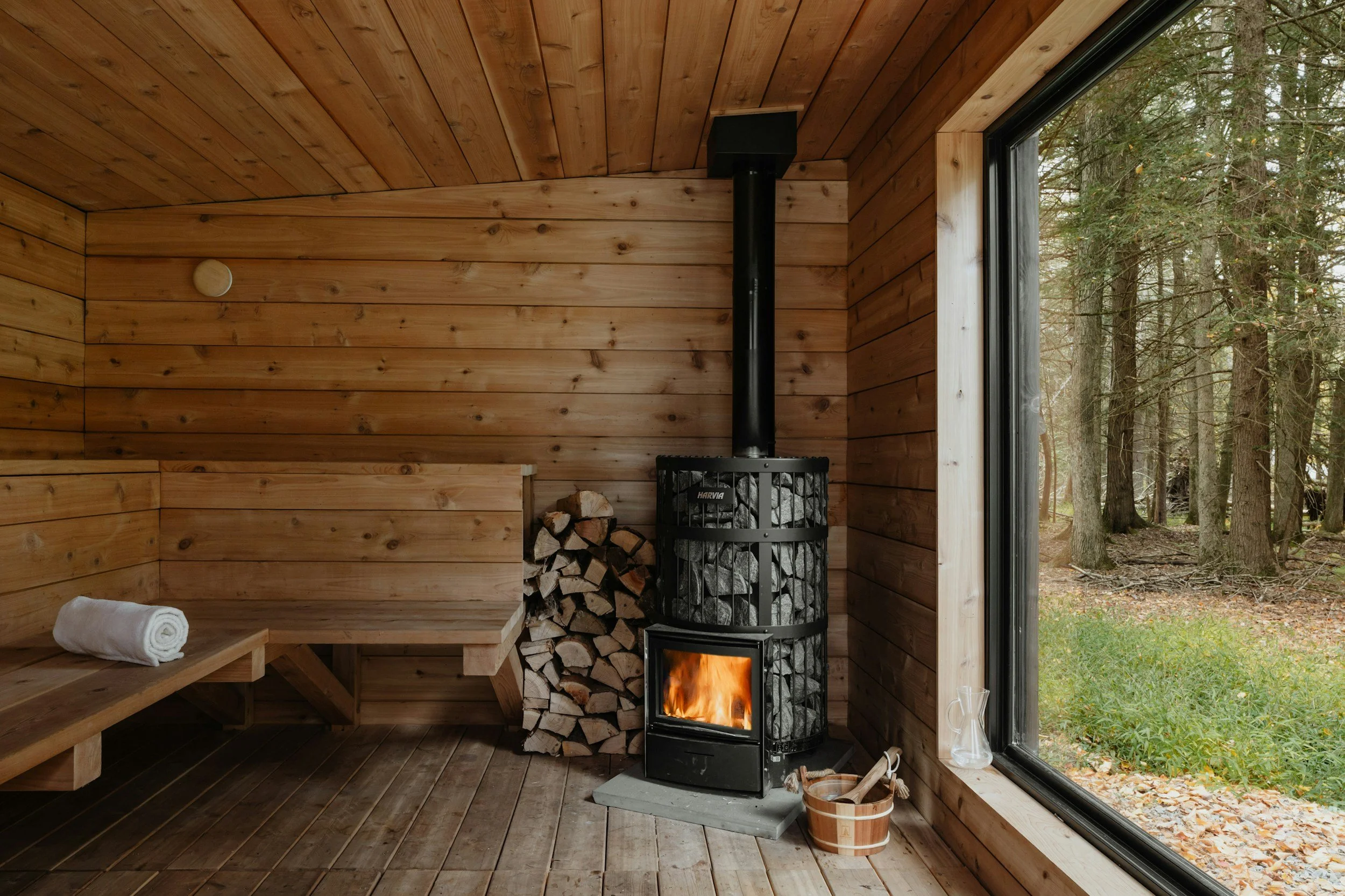
Beth runs a sauna in a woodland setting for people needing time and space to recover from personal trauma. This might be anything from a slight misalignment (often referred to as a small ‘t’ trauma) to a full-blown, debilitating ‘T’ trauma. The sauna’s surroundings are designed to promote healing and help the unconscious mind ease into parasympathetic autonomous mode; to switch off the fight or flight response and release the hypervigilance associated with trauma.
To allow this to happen, we need to develop the ability to be present in the moment. We can stop the repeated patterns of thought and behaviour that aren’t serving us and pay attention to what is restorative. Creating the conditions that have the potential to bring about a sense of calm have an important part to play in this process.
Beth’s woodland sauna is one such calming setting. When she spoke at a recent conference held in Inverness for practitioners interested in neuroplastic symptoms, she described how environmental safety is vital to what she does as a wellbeing practitioner.
Safety is built into absolutely everything I do, but a kind of safety that is different to the sterile, risk-assessed environments of institutions.
Safety is found in mindful attention to detail. I make sure that people can see that I have thought about their delight and their welfare. I searched the nearby woodland for mossy logs to line the winding entrance path from the track. I made shady corners with hammocks and wove the branches into canopies. A wonky gate made of twisty branches introduces you to the space. Fairy-tale stories were my refuge as a child, and creating a fairy-tale space for others is my therapy, too. The space is playful but the intention and effect are very serious.
This sense of restorative safety can be nurtured in many other ways, of course. Any activity that requires you to concentrate in the moment is good for this. Climbing, gardening, playing a team sport, gardening, sewing, bungee jumping - the list goes on. Anything that is life-affirming and brings about a sense of calm for you is worth considering. There are many ways to develop a deeper sense of presence in addition to activities, such as deep breathing and engaging your senses through paying attention to smell, sound, colour and touch.
Beth has worked hard to develop small enclaves where individuals can be alone and at peace.
I deliberately planned a safe corner in a bush like a childhood den, with patchwork blankets, for if you need some time away from other people. I make it clear that all feelings are welcome and that they will be given a safe haven. Especially feelings like anxiety and lack of entitlement and worry that you’re not good enough.
This keen attention to detail comes from Beth’s own experience of therapy in clinical rooms that lacked emotional warmth. Her childhood was difficult. By the time she was fifteen her family had moved house ten times, oscillating between two countries with very different cultures. Her parents were addicted to alcohol and prescription drugs, and she grew up in a volatile, unsettling and often frightening environment.
Beth says: “I remember the first time I ever felt safe. I was 30. I had finally made it to university and was living in halls of residence (a beautiful former manor house with lovely gardens), in a room of my own, at the end of a long, quiet corridor. Only I had a key to my room and there was a security guard at the front door.”
Beth did exceptionally well at university and has turned her life around since. She knows the importance of feeling safe, even if this is difficult at times.
Safety is very elusive still. But at university, I felt safe enough to stay at home and study. I got a first. It was a tremendous healing for me, as I’d been thrown out of school at 16 for always being angry and disruptive. My alcoholic form tutor sided with my dad, when I told him that my dad beat me up. They sat up all night drinking whisky in our sitting room, while my stomach dropped through the floor.
Anyone reading this who has had their own difficult childhood to address will most likely feel for Beth, but it is a story of inspiration. Beth was homeless for a while and there were awful times. But along the way she was occasionally offered help and, most importantly, she chose to help herself. She courageously recognised the importance of feeling safe, both internally and externally, and at the age of 30 this became a key factor in her new future. With hope and self-confidence renewed, this future has room for self-expression and healing for herself as well as others. For Beth, this includes paying a lot of attention to the physical environment.
I’ve spent a lot of time in therapy rooms and they never feel homely because they are functionalist. The aesthetic values of the architecture and interior design almost always reflect this too. It’s hard to feel better when you feel like an object. 50 minutes a week in an office chair with very little visual joy makes progress a long road.
When was the last time you thought about your environment? Beth gives us lots of ideas of what constitutes safety for her. What helps you to feel safe? Please comment below if you’d like to share your ideas.
Here are the details of the sauna space Beth designed: Stanmer Sauna Garden, in Brighton, East Sussex, a non-profit community sauna in the UK.
Beth’s sauna recently won: Best Health/Outreach Sauna 2026 at The British Sauna Society Summit Awards!